
The Ouroboros of “Philanthropy”
Ou·ro·bo·ros ˌyu̇r-ō-ˈbȯr-əs
variants or ouroboros or less commonly Uroboros or uroboros
1: a circular symbol that depicts a snake or dragon devouring its own tail and that is used especially to represent the eternal cycle of destruction and rebirth
2: usually ouroboros or less commonly uroboros : something (such as a never-ending cycle) that is likened to or suggestive of the Ouroboros symbol
JPMorgan Chase just announced a $40 million initiative to create or sustain 6,000 jobs. And honestly, who's going to argue with that? Not in an economy where graduates leave college buried in debt, social security is quietly hollowing out, the housing market looks less like an asset and more like a dare, and the job market is about as welcoming as the debt that got you there in the first place.
The headlines called it transformational economic leadership. Let’s look at the numbers first.
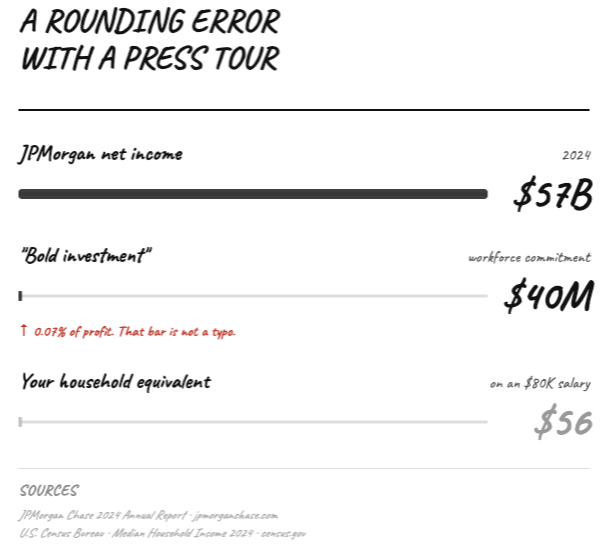
JPMorgan generated $57 billion in net income last year. The $40 million commitment represents 0.07% of that profit. For an average American household earning $80,000 annually, the proportional equivalent is about $56. That is not a bold bet on the future of work. It is a rounding error with a press tour.
What I will be watching for, between now and the next time these conversations reconvene, is evidence of a shift from diagnosis to design, from consensus on the problem to accountability for the response. The question worth asking at next year’s Forum is not what we discussed, but what changed.
Documented U.S. workforce shortages by sector. Sources: Learning Policy Institute (2025), AAMC (2024), BLS.
But the size is almost beside the point.
The more important question is which jobs? Right now, the Association of American Medical Colleges projects a shortage of over 85,000 physicians by 2036, with burnout and chronic understaffing pushing healthcare workers out of the profession faster than the pipeline can replace them. According to the Learning Policy Institute, roughly one in eight teaching positions nationally is either unfilled or filled by someone not fully certified for the role — a number that has increased every year since tracking began. Rural hospitals are closing. Public schools are running on substitutes. These are not abstract labor market statistics. They are structural failures accumulating in real communities, right now, at a moment when the workforce gaps are widening faster than any voluntary initiative is closing them.
JPMorgan’s $40 million is not going to any of those places.
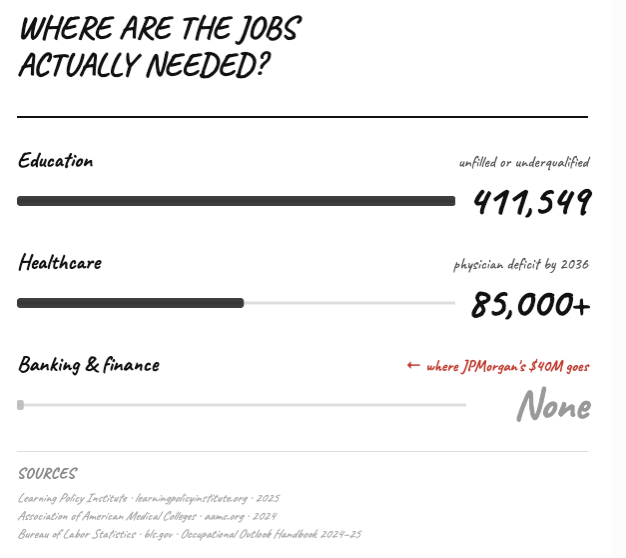
It is going, largely, toward the financial and professional services ecosystem — the talent pipeline, the adjacent industries, the workforce infrastructure that feeds institutions like JPMorgan. When it goes to small businesses (which is so far down the attribution pipeline of their model, the line is more of a distant dot), it goes to businesses that will then reinvest in the financial infrastructure provided by JPMorgan.
That is not philanthropy. It is an Ouroboros. It is a company investing in its own microeconomy and calling it impact. The workers being created or sustained here are not the workers society is running out of. They are the workers, and (more importantly) clients that JPMorgan needs to secure a future of continuously rising bonuses and golf.
So. Much. Golf.
This matters because of how the investment is structured. Routed through philanthropic and community development vehicles, these commitments generate tax benefits, ESG credibility, reputational gains, and political goodwill — all while the corporation maintains significant influence over where social impact capital actually flows. The communities facing the deepest workforce crises, rural healthcare systems, underfunded public schools, and vocational pathways in advanced manufacturing continue operating under chronic underinvestment.
“These people often use philanthropy as a way to distract people from the fact that they’re not paying their taxes,” historian Rutger Bregman told a room of billionaires at Davos, all the way back in 2019. “I really think you need to look at how philanthropy is actually being used: Is it genuine, or is it a way to distract?” The question still holds today, perhaps even more pointedly and urgently.
That question has not gotten easier to answer since he asked it.
A modest increase in what institutions like JPMorgan actually contribute through the tax base — without philanthropic credits, without reputational architecture, without curated press announcements — would direct more capital toward the underfunded systems this initiative gestures toward than any number of $40 million commitments. The math is not complicated. The politics are.
None of this means JPMorgan’s initiative helps no one. Some of those 6,000 jobs will matter to real people. The question is not whether this is good. The question is whether it is honest about what it is, and whether the social impact sector is willing to hold that distinction clearly.
Because if we keep measuring corporate impact by headline size rather than proportionality, systemic relevance, and the distance between the investment and the investor’s own interests, we are not evaluating impact. We are celebrating the architecture of it.
The sector is capable of demanding more. The harder question is whether it will.
The Writer is the CEO of Sowen, a Social Impact consulting firm. He is often annoyed when people and organizations exhibit unethical behavior. So, he’s often annoyed, but he’s learning how to be OK with it.